Early Stage VC Firms in India: Which Tier Can Actually Fund You (2026)
The short answer: a fund's minimum cheque and its target ownership together set the smallest valuation it can invest at. Divide one by the other. If a fund needs ₹8 Cr in and 15% of the company, it cannot lead a round below roughly ₹53 Cr post-money, no matter how good your deck is. Most founders raising their first institutional round in India are pitching a tier that is arithmetically out of reach.
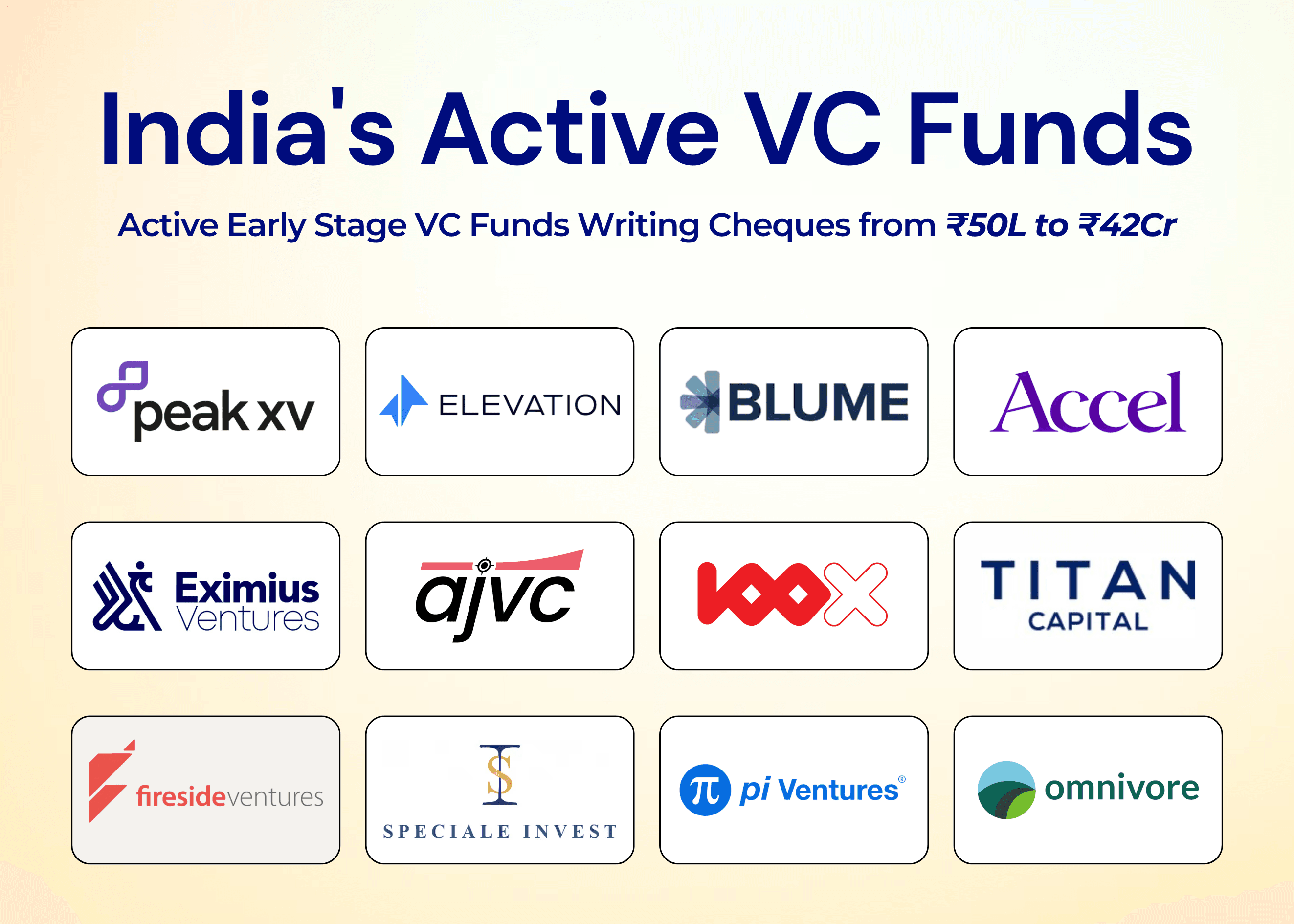
Around 50 early stage VC firms in India actively write first and second cheques, and they are not interchangeable.
Below: cheque ranges in rupees, the arithmetic that filters the list down to funds that can say yes, and the order to approach them in.

Run the outreach as one batch over six weeks, not one fund at a time
Sequential outreach is the expensive mistake here: the funds that pass early are the ones whose feedback would have improved the pitch for everyone else.
- Fix your raise number from a milestone. What must be true before your next round, what it costs to get there, plus six months of buffer. That number sets everything downstream.
- Run the division and cut the list. Delete every fund whose floor sits above your implied post-money. Expect 50 names to become 15 to 20.
- Check readiness before the first email, not after the fifth pass. Backrr's Fundability Report scores Problem & Market, Team & Expertise, Business & GTM, Funding & Utilization and an Investor Lens separately, so a weak section shows up as a section rather than as a silent rejection.
- Open all 15 to 20 in the same fortnight. Parallel conversations create the timing pressure that produces a term sheet. Sequential ones produce a nine-month raise.
- Track status per investor in one place. Backrr's Investor Pipeline holds each fund at Invited, Interested or Rejected, with allocated amounts and toggles for lead investor, KYC and agreements signed, the columns founders otherwise improvise mid-raise.
- Follow up on evidence, not on a calendar. The Profile Views tab on your Backrr Page names the investors who opened it and when they last looked, so a nudge lands the day someone is reading.
Bottom line: six weeks of parallel outreach to 15 correctly filtered funds beats six months of sequential outreach to 50.
Five mistakes that cost founders a quarter
- Pitching a tier that cannot invest at your valuation. Not a soft no. A structural no, and the arithmetic was available before the email went out.
- Letting the ESOP pool be created pre-money without pricing it. Indian startups typically reserve 10–15% of fully diluted equity for ESOPs, and investors commonly require the pool to be created pre-money, so the dilution falls on existing shareholders rather than on the new money. A 10% pre-money pool on a ₹4 Cr round at ₹20 Cr post costs founders roughly two extra percentage points versus a post-money pool, about ₹40 lakh of value at that valuation, and more at every round after.
- Raising more than the milestone needs. A larger round at the same ownership target sets a higher Series A bar: ₹10 Cr at ₹50 Cr post means the next round has to clear roughly ₹150 Cr to be a good one.
- Quoting ownership that ignores the pool and the preference. Backrr's Cap Table holds each investor's share class alongside current and fully diluted ownership, so the number you quote survives diligence.
- Treating a cold email as the only door. Several funds in the micro VC table run public application forms with published decision timelines, faster than hunting for a warm introduction.
FAQ
How many early stage VC firms should I approach?
Fifteen to twenty that clear the cheque-size filter. Below ten, one bad quarter kills the round; above thirty, the outreach stops being specific enough to get replies.
Do Indian VCs read cold emails?
Micro VCs and pre-seed funds routinely do, and several publish an application form specifically so you do not need an introduction. Tier 1 funds at seed still run mostly on warm referral and portfolio-founder sourcing.
What is a realistic pre-seed cheque in India?
Commonly ₹20 lakh to ₹2 crore, funding an MVP, the first hires and initial market validation. Seed rounds commonly run ₹2 crore to ₹15 crore once there is revenue or validated usage.
Should I take a smaller cheque from a micro VC or wait for a larger fund?
Take the cheque sized for your milestone. Waiting to clear a Tier 1 fund's valuation floor usually costs more runway than the extra capital is worth, and a micro VC lead often brings the larger fund in next round anyway.
Is venture capital the right instrument at all?
Not always. If your growth is capital-efficient and revenue is predictable, venture debt or an Indian family office can fund the same milestone with far less dilution.
I am building outside a metro. Does that change the list?
It narrows it usefully. A separate set of funds and angel networks actively targets Tier 2 and Tier 3 startups, and they underwrite non-metro traction on its own terms rather than discounting it.
Where Backrr fits in this
Once the list is filtered, the work is discovery, readiness and tracking. Backrr's Investor Network matches investors to your company profile with type, location and cheque size range attached, so the filter above runs against a live list rather than a static page. The Fundability Report tells you whether the pitch survives a first screen, the Investor Pipeline holds all twenty conversations while they run in parallel, and the Cap Table keeps ownership accurate after the pool and the preference are counted.
Backrr does not find funding or make introductions. It replaces the spreadsheet, the scattered documents and the manual chasing a raise otherwise runs on, you can set that up here.
The takeaway: run one division before you run any outreach. Minimum cheque divided by target ownership tells you which of these funds can say yes at your valuation, and the fifteen that pass that test are worth more than the fifty that do not.